

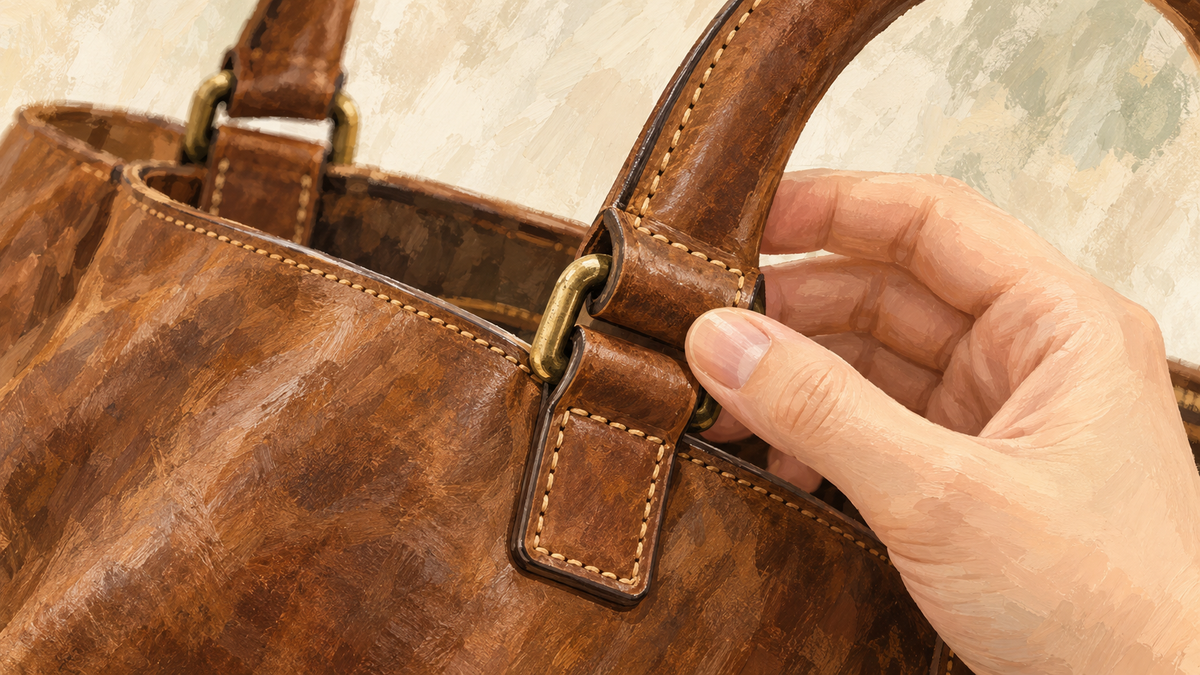
What Makes Good Leather? A Closer Look at Full Grain, Finish and Bag Construction
A close-up of leather catches your eye, and the product page offers words like 'full grain', 'genuine leather' and 'premium'. It sounds promising, but what should you look at to choose with confidence?
Alongside the texture you like, look at stitching, handles and closures. The bag as a whole begins to come into view. Let's untangle a few material terms and look for something that will feel good to use.
Full grain describes how the leather's surface is treated
Full-grain leather retains the outer grain surface rather than having it sanded away. Natural creases and markings may remain visible, making it an interesting choice if you enjoy that individuality.
It doesn't mean the leather has never been dyed or finished, and the words 'full grain' don't determine every aspect of a finished bag's quality. Look at thickness, workmanship and the shape you'll use alongside the label.

Even surfaces and varied tones each have their appeal
A refined, even surface has its own appeal, while visible grain and varied tones can feel more relaxed. Your preference may depend on what you'll wear it with and how you plan to use it.
You might like a clean impression for work and more scuff-friendly, varied leather for weekends. It's fine for your favourite leather to change with the occasion. When wondering about price differences, look at finish and construction together.
A bag's qualities include the parts you touch every day
Opening a zip, gripping a handle, putting keys in an inner pocket. Satisfaction with a bag comes from these small movements as well as the leather's surface.
In photographs, examine seams, corners, handle bases and lining. Do the reinforced areas and storage layout suit the way you carry things? Widen your view from the material label to the bag as a useful object.

Compare two cowhide bags by their different shapes
For work essentials, would a tote or a business bag with dividers suit you better? Picturing the movements involved helps you recognise which construction details matter to you.
A cowhide tote for relaxed workwear

A tote measuring approximately 36 × 28 × 10 cm, with a zip closure and pockets inside and at the back. Consider it if you like putting things in and out together through one opening. Compare pocket positions and the dimensions of your laptop case as well as the leather surface.
A cowhide business bag for keeping things organised

Approximately 40 × 11 × 29 cm and 1.8 kg, with zip and press-stud closures, inner dividers and small-item pockets. For those who want separate places for work tools. The bag has some weight of its own, so consider your daily travel distance and how much you carry.
Fitting your life matters for long-term use, too
Even leather you love may stay at home if the bag is too heavy or won't hold your things. Check measurements and weight to choose a piece you can use comfortably and often.
Once you begin using it, remove dust and let it dry after rain. Enjoy light scuffs, while getting advice early about torn handles or loose stitching. Both a thoughtful choice and everyday care support the time you spend with a favourite.

Questions about material labels
Does full grain mean an untreated surface?
It means the grain surface hasn't been sanded away. Whether it has been dyed or finished is a separate question. Read the product's description for its feel and care needs.
Do creases or small marks mean poor quality?
They can be part of a natural material's character. Tears, loose stitching or serious peeling are different. If something concerns you when an item arrives, ask the retailer before using it.
Does 'genuine leather' mean it is full grain?
Genuine leather and full grain describe different things. The genuine-leather label alone doesn't establish how the surface has been processed.
Looking for good leather is also a way of learning what you enjoy. Go beyond how a name sounds to a surface you love looking at and construction that seems pleasant to use. Choose with both in mind.
About the author

Yama (Cowmono Owner)
With experience in sales and marketing at apparel companies in Japan and abroad, Yama selects and introduces leather goods that fit naturally into everyday life.
